


Watching a tennis match and following how a market reads that same match are two different experiences. One tells you who is winning. The other tells you what a room full of people think is about to happen, updated point by point.
Tennis suits this better than almost any other sport. There is play somewhere on the calendar nearly every week of the year, across the main tours and the Challenger and ITF circuits underneath them. That means market activity rarely goes quiet.
This guide looks at five platforms where tennis outcomes can be followed and traded as event contracts: Fanatics Markets, Kalshi, Polymarket, DraftKings Predictions and FanDuel Predicts.
Finding the right fit for how you follow tennis
Before getting into the details, here is a quick way to narrow things down.
If you want tennis given its own dedicated section, with live set scores and the payout shown right next to the probability, look at Fanatics Markets.
If you want deep coverage running from Grand Slam winner markets down through Challenger events, look at Kalshi.
If you want the widest spread of event markets across sport and everything else, look at Polymarket.
If you are coming from a sportsbook background and want something that feels familiar, look at DraftKings Predictions.
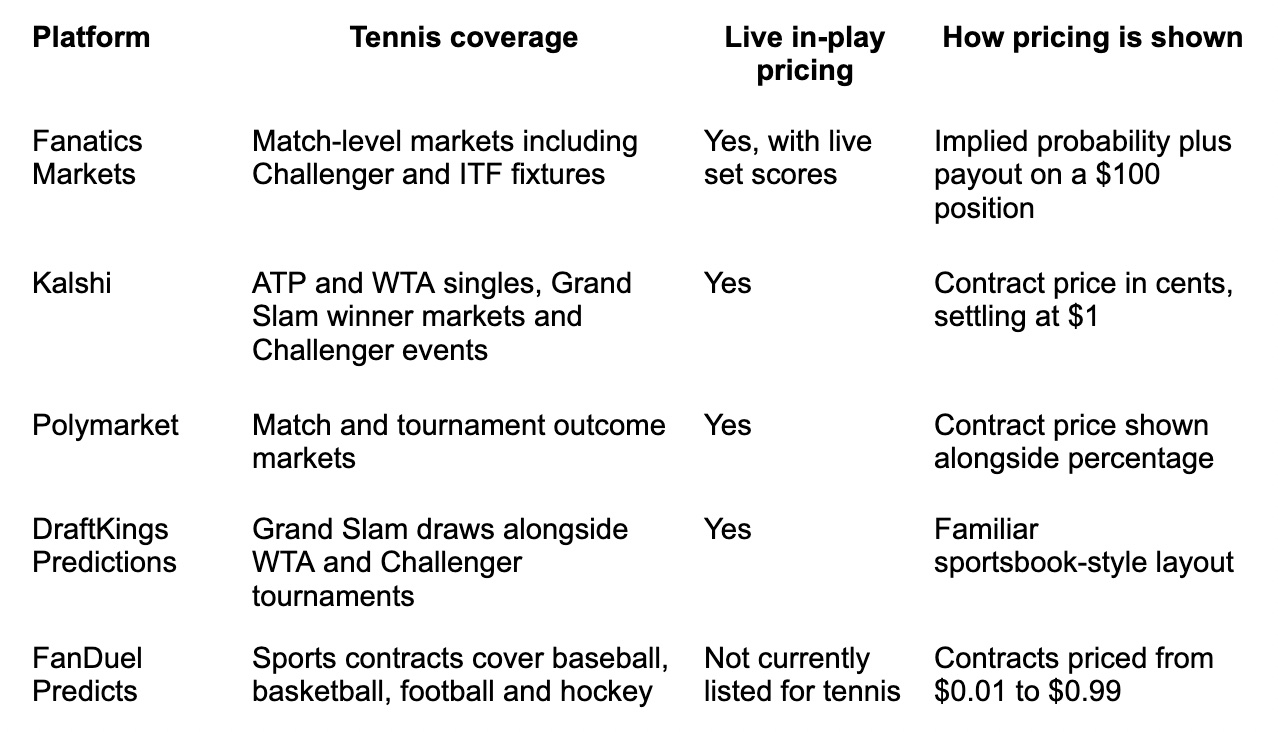
Tennis market coverage compared
What separates one tennis platform from another
Once you understand the mechanics, the differences between platforms come down to a handful of things.
- Depth of coverage. Some platforms list only main tour matches. Others go deeper into Challenger and ITF events, which matters if you follow tennis year-round rather than just the majors.
- Live pricing. Whether markets stay open and keep moving during play, or close once a match starts.
- Display clarity. How plainly probability and payout are laid out. This sounds minor until you are trying to read a market during a tiebreak.
- Market types. Several platforms list match winner markets only. Others add set and game markets on top.
- Liquidity. How much money is actually moving on a given match. Thin markets are harder to exit.
- Regulatory structure. How the platform is overseen and where your funds sit.
Platforms worth considering for tennis markets
These are grouped by what each one suits, not ranked by quality. What works for someone trading during live play is not what works for someone checking in once a tournament.
Fanatics Markets
Fanatics Markets is a sports-first prediction markets platform that sits inside the wider Fanatics ecosystem. It runs a dedicated tennis section rather than folding tennis into a general sports category, which is worth noting if tennis is your main interest.
Every tennis market on the platform is priced as a moneyline, and Fanatics Markets tennis lines display each player’s implied probability next to the payout on a $100 position, with live set-by-set scores shown on matches already underway. Coverage reaches down into Challenger and ITF match play, so there is usually something live regardless of where the calendar sits.
- Moneyline markets on individual matches
- Live pricing that keeps moving during play
- Implied probability shown per player, alongside payout
- Contracts offered under a CFTC-registered structure
Kalshi
Kalshi operates as a regulated exchange covering a wide range of categories, with sports sitting alongside politics, economics and culture. Its tennis coverage is substantial, running from Grand Slam winner markets through ATP and WTA singles down to Challenger events.
The interface leans toward a trading tool rather than a sportsbook, with contracts priced in cents and settling at a dollar. People who like seeing market structure tend to get on well with it.
- Grand Slam, ATP, WTA and Challenger tennis markets
- Contracts priced in cents, settling at $1
- Sports listed alongside non-sports categories
- Suits users comfortable with exchange-style pricing
Polymarket
Polymarket is known for breadth. It lists an enormous range of event markets, and during major sporting events the volume moving through it can be substantial.
Funding is built around crypto rails, though the US platform also takes debit card, ACH and wire transfers, so you are not forced into crypto just to get started. Whether that setup suits you depends on how you prefer to move money in and out.
- Wide selection of event markets
- Heavy activity around major events
- Crypto and fiat funding options available
- Suits users comfortable operating in crypto
DraftKings Predictions
DraftKings Predictions already know. The design deliberately mirrors the experience people are used to, which lowers the learning curve.
Tennis listings currently include both US Open draws alongside WTA and Challenger tournaments. Positions can be bought and sold before settlement, so the mechanics are the same as anywhere else even though the presentation feels familiar.
- Grand Slam, WTA and Challenger tennis listings
- Positions can be traded before settlement
- Event contracts with a recognizable sports interface
- Suits people moving across from a sportsbook background
FanDuel Predicts
FanDuel Predicts is the event contract offering from another established sports operator, built around financial benchmarks and economic indicators alongside a sports line-up.
Its sports contracts currently cover baseball, basketball, football and hockey, so tennis is not part of the line-up at the moment. Worth keeping an eye on as the platform expands, but not somewhere to look for tennis markets today.
- Event contracts from a well-known sports brand
- Contracts priced from $0.01 to $0.99
- Financial and economic markets alongside sport
- Tennis not currently among the sports covered
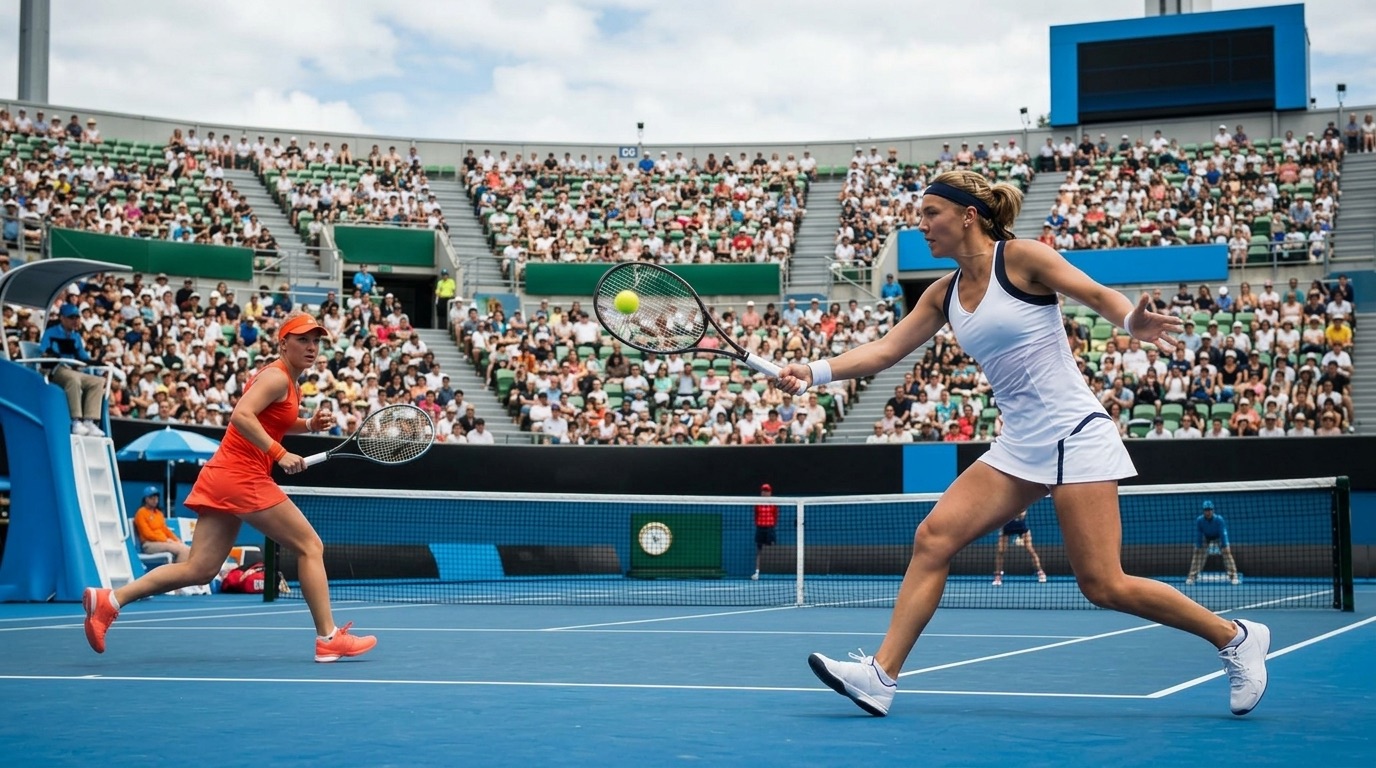
How market prices move during a live match
Tennis pricing moves in a way that is genuinely different from most sports.
In football or basketball, scoring is continuous, so probability drifts. In tennis, everything hinges on a handful of moments. A single break of serve can swing a market hard, because holding serve is the baseline expectation and breaking it changes the entire shape of the set.
Watch a market during a deuce game at 4-4, and you will see it. The percentage barely moves through the early points, then jumps the moment break point arrives, then jumps again when the point is decided.
It is easier to spot when you are watching with other people. Follow a match at a local sports bar and the room usually reacts a beat before the number does, which makes the whole mechanism obvious in a way that staring at a screen alone never quite does.
One thing that confuses people: the two players’ percentages usually add up to slightly more than 100. You might see 45 and 56. That is not a glitch. The gap is the spread sitting between the two sides of the market, and it is entirely normal.
How these platforms are regulated
Event contract platforms in the US generally operate under Commodity Futures Trading Commission oversight, as regulated exchanges rather than under the state-by-state licensing model that applies to sportsbooks.
That difference in structure is why availability patterns look different from traditional sports betting. It also means the disclosures you see on these platforms are framed around trading risk rather than gambling terms.
Regulatory questions in this space are still being worked through, and the picture continues to develop. Checking a platform’s own regulatory page before signing up is worth the two minutes it takes.
Wrapping up
There is no single right answer here, because people follow tennis in very different ways. Someone tracking Challenger results in February needs something different from someone who tunes in for two weeks in July.
Run the platforms above against the criteria we covered: how deep the tennis coverage goes, whether markets stay live during play, how clearly pricing is displayed, and how much money is actually moving. Those four questions will narrow it down faster than any ranking.
Then start small. Watching one market through a full match teaches you more about how these things move than any amount of reading.
Frequently asked questions
- How does a tennis event contract differ from a traditional wager?: A traditional wager is locked in once placed, and you wait for the result. An event contract is a position you hold, and its value moves as the market reprices the outcome. You can usually sell out of it before the match ends rather than waiting for settlement.
- Can a position be closed before a match finishes?: On most platforms, yes. As long as there is enough activity in that market, you can sell your position at the current price mid-match. How smoothly that works depends on liquidity, which tends to be thinner on lower-tier matches.
- Why do the two players’ percentages add up to more than 100?: Because the spread sits between the two sides. If you see 45 and 56, the extra one percent is the gap between what you would pay to buy each side. It is standard across these platforms and not an error in the display.
- Are tennis markets available outside the four Grand Slams?: Generally yes, though it varies by platform. Some list matches across the main tours and the Challenger and ITF circuits year-round, while others concentrate on the bigger tournaments. If off-season and lower-tier coverage matters to you, check the tennis section directly before signing up.
Disclaimer: This article is for informational purposes only and isn’t financial, legal, or gambling advice. Availability, odds, and legality of these platforms vary by location and can change at any time, so verify current terms before signing up. These platforms carry financial risk — only participate with money you can afford to lose, and age restrictions (18+ or 21+) apply. If gambling ever stops feeling fun, help is available 24/7 at the National Problem Gambling Helpline: 1-800-522-4700.